





Jakarta, Otodiva—The increasingly severe dynamics of the automotive industry have made PT Astra International Tbk (Astra Group) have to change strategy. In the performance report for semester I-2025, Astra Group shows that even though the automotive market is experiencing pressure, The company continues to strive to maintain growth through business diversification into potential sectors, like health, renewable energy, infrastructure, to digital technology.

The national four-wheeled car market is down 9% become 375 thousand units. Astra's market share was also corrected from 57% become 54%. The hardest hit segment is low-end cars. To maintain dominance, Astra prepares to launch a new model, promotional package, and more competitive after-sales service.
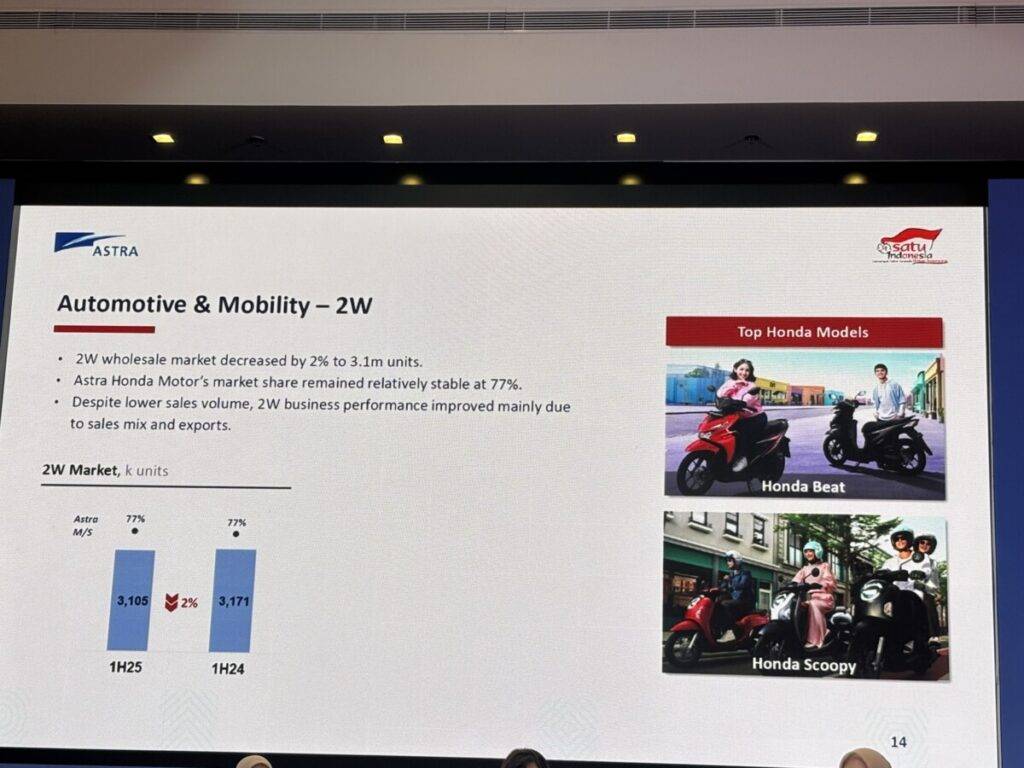
On the two-wheeler side, the market fell slightly 2% become 3,1 million units. However, Astra Honda Motor continues to maintain a stable market share at the level 77%. Although sales volume has decreased, performance is still supported by sales of high-end models and exports.
According to Tira Ardianti, Head of Investor Relations PT Astra International Tbk, a decline in the automotive market is inevitable, However, Astra is still trying to maintain its position. “We realize that the challenges in the automotive sector are quite large, especially in the entry level segment. Because of that, Astra focuses on more innovative product strategies, operational efficiency, and strengthen after-sales service,"He explained.
The United Tractors unit is facing quite heavy pressure. Net profit falls 15% to IDR 5 trillion. This decline was due to weak performance in mining services and weak coal prices. Nevertheless, The heavy equipment and gold sales segments are able to provide a cushion.
New Business Engine for Astra Business Growth
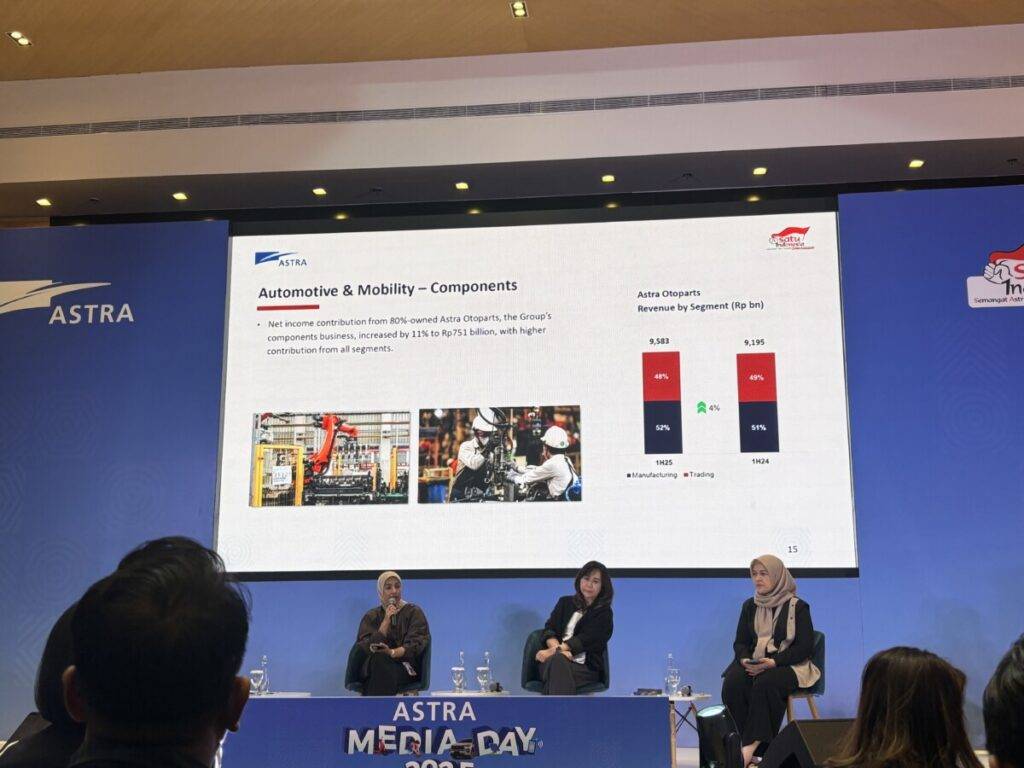
The component business through Astra Otoparts shows an increase. Net profit grows 11% to IDR 751 billion, supported by positive contributions from all lines.
In the mobility sector, Autoraya Compatibility (SERA) succeeded in maintaining performance through sales of ex-rental vehicles and increasing logistics business.
One of Astra's new growth engines emerged from the digital technology sector through OLXmobbi. This used car buying and selling platform recorded a spike in sales 26% become 15 thousand units throughout the I-2025 semester. This growth marks a shift in consumer behavior who are increasingly comfortable transacting online.
Not just transactions, OLXmobbi also develops digital ecosystem services, starting from vehicle inspection, financing, to logistics integration. This innovation strengthens Astra's position as an important player in the digital transformation of the automotive industry.
Mariam Sanad, Senior Analyst Corporate Investor Astra, emphasized that digitalization through OLXmobbi is part of a long-term strategy. "We see that OLXmobbi is not just a buying and selling platform, but the forerunner of a digital ecosystem that can support Astra's automotive business in the future. Consistent growth proves that this strategy is right to answer the needs of the new generation of consumers,” he said.
Astra's financial services division provided a significant contribution. Net profit increases 6% to IDR 4.4 trillion. The driver is greater consumer financing, growth of multipurpose financing, and stable asset quality.
The Astra Agro Lestari Business Unit is still in existence backbone this business group recorded brilliant performance. Net profit rises 40% to IDR 5.9 billion thanks to the increase in CPO prices and sales volume.
Astra's infrastructure business manages eight toll roads along the way 396 km recorded an increase in net profit 38% to IDR 636 billion. The drivers are increasing traffic volumes and rising fares.
Health Sector, Renewable Energy and Logistics: Future Business Directions
Astra Group is increasingly serious about working on the health business. Investment has been made in Halodoc (31%), Hermina (21%), to the acquisition of a majority stake in Heartology Cardiovascular Hospital at the end 2024. With a total investment value reaching IDR 8.6 trillion, Astra hopes that this sector can become a new growth engine.
Mariam added, “We see the health sector as having strong long-term growth prospects. By investing in Halodoc, Hermina Hospital, to Heartology Cardiovascular Hospital building a solid foundation in a sector with growing needs in Indonesia.”
Apart from health, Astra is also expanding its portfolio in renewable energy. United Tractors increases its stake in Supreme Energy by up to 40,4%, who manages geothermal projects. In the logistics sector, Astra is preparing expansion through the acquisition of industrial warehouse assets to strengthen its business ecosystem.
Throughout January–June 2025, Astra Group recorded revenue of IDR 162.9 trillion, naik 2% compared to the same period last year. However, consolidated net profit fell slightly 2% to IDR 15.5 trillion.
The decline in profit was mainly due to weak mining and automotive businesses. Even so, financial services sector, agribusiness, infrastructure, and digital technology can withstand pressure.
With seven core business pillars and aggressive diversification steps, Astra strives to maintain competitiveness. Diversified portfolio—starting from automotive, finance, heavy equipment, agribusiness, infrastructure, OF, property, health, to digital technology—making Astra remain resilient in the midst of challenges.
Paradiva, From this strategy it is clear that Astra Group does not only rely on the automotive business as its backbone, but also prepare new foundations in the health sector, green energy, to digitization via OLXmobbi and Halodoc. This direction is key to maintaining long-term growth, while responding to the increasingly difficult challenges of the automotive industry.


